How M3 works
M3 is a deep generative framework for condition-aware integration, patient-level inference, and multi-resolution interpretation of multimodal single-cell omics data across multiple biological conditions and samples.
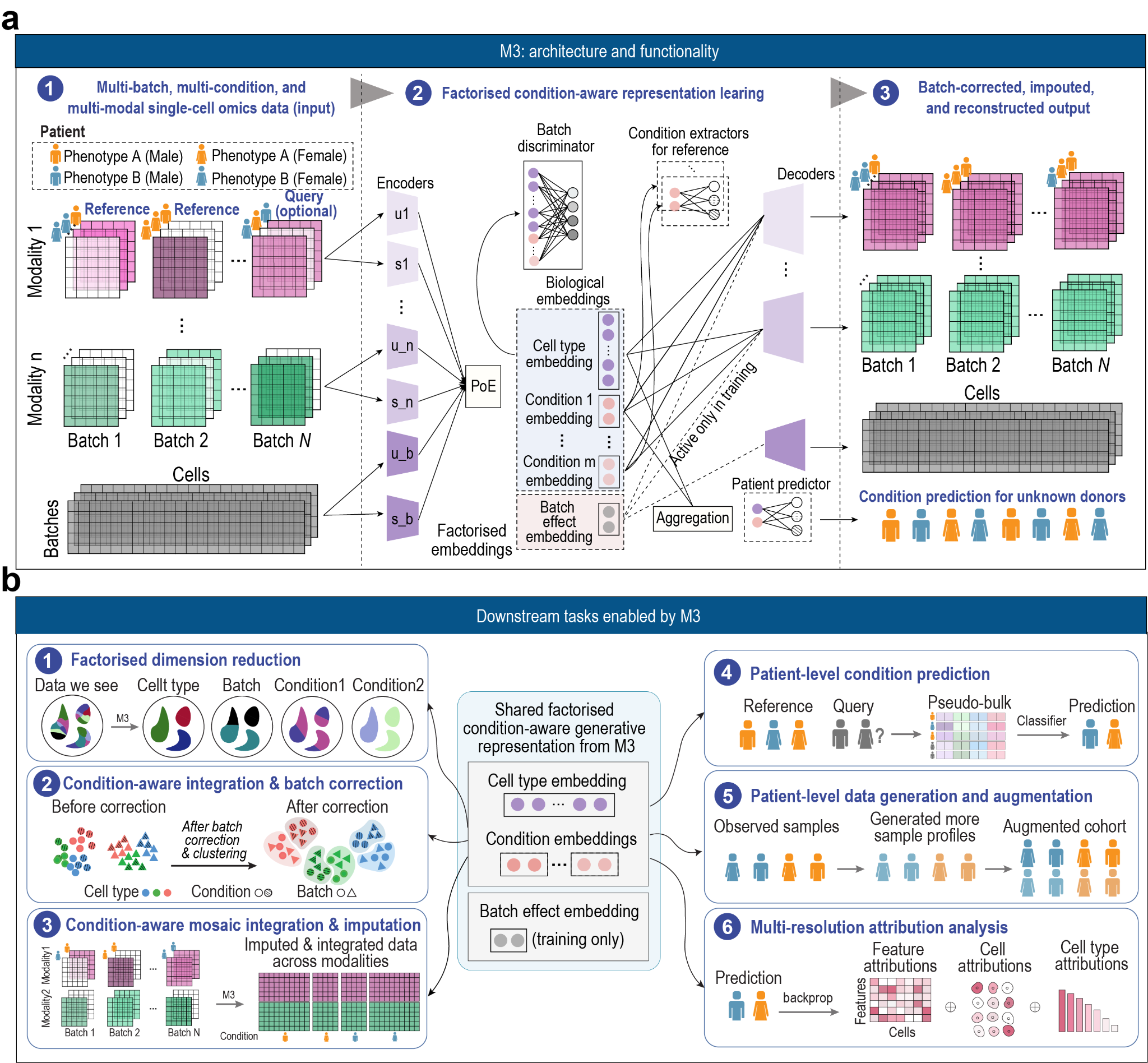
(a) M3 takes multi-batch, multi-condition, multimodal single-cell data as input. Per-modality encoders are fused by a product-of-experts into a shared biological embedding per cell, and M3 learns factorised embeddings that separate cell-type, condition, and batch-effect variation. A batch discriminator (applied adversarially) makes the biological embedding batch-invariant while condition extractors preserve condition-dependent signal; decoders reconstruct batch-corrected, imputed output, and a patient predictor aggregates cells into per-donor pseudo-bulk to infer the condition of unknown donors. (b) Because every result is decoded from the same shared, condition-aware representation, the six downstream tasks stay internally consistent.
The model
M3 is built on a variational autoencoder (VAE). For each modality, a modality-specific encoder maps molecular features into a latent representation, and these are fused through a product-of-experts (PoE) into one shared biological embedding per cell — which lets M3 handle both fully observed and mosaic designs (where some samples are profiled with only a subset of modalities).
Crucially, M3 learns factorised embeddings that separate sources of variation explicitly: a biological factor (cell type), one condition factor per declared condition, and a batch factor. During training all factors — including the batch factor — are passed to the decoders, so reconstruction can account for batch-specific technical effects while optimising. A batch discriminator pushes the biological embedding to be batch-invariant, while condition extractors preserve condition-dependent biology, so batch correction does not overcorrect the signal you actually care about. At inference the batch factor is excluded, and because every downstream result is decoded from this single shared, condition-aware representation, M3 stays internally consistent across tasks instead of bolting separate task-specific models together.
The six tasks
The package exposes these capabilities through one m3.M3 object:
| # | Task | What you get | API |
|---|---|---|---|
| 1 | Factorised dimension reduction | condition-aware cell embeddings for clustering / UMAP | embedding |
| 2 | Condition-aware batch correction | batch-corrected, condition-preserving matrices | reconstruct |
| 3 | Mosaic integration & imputation | one embedding across samples that are missing a modality | concat + reconstruct |
| 4 | Patient-level condition inference | per-donor condition prediction on held-out samples | predict_donors |
| 5 | Patient-level sample generation | synthetic donors / cells to augment small studies | augment, generate |
| 6 | Multi-resolution attribution | a condition attributed back to genes, cells, and cell types | attribute |
When to use M3
Reach for M3 when you have multimodal, multi-condition, or multi-sample data and want to:
- Integrate across batches, conditions, and modalities while preserving condition signal, and impute missing modalities in mosaic designs.
- Reconstruct batch-corrected matrices for reproducible differential expression.
- Infer at the patient level, aggregating cell embeddings into pseudo-bulk profiles to predict a sample's condition (for example, disease status) on unseen query samples.
- Generate synthetic patient profiles to augment small studies.
- Interpret at multiple resolutions, attributing a condition back to genes, individual cells, and cell types.
How M3 is trained
Training is handled inside M3.train:
- Integration VAE. Learns the factorised cell embedding. When a sample is
held out at construction (
held_out=[...]for a whole batch, orheld_out_samples=[...]for specific donors, passed tom3.M3(...)), its condition labels are masked during training so they cannot leak into the representation. - Donor predictor (optional). An adversarial corrector aggregates cells into
per-donor pseudo-bulk vectors, removes residual batch structure, and predicts
the donor's condition. It trains automatically whenever both
donor_keyandcelltype_keyare supplied, and underpinspredict_donorsandattribute.
Get going
- Install —
pip install m3-sc, and PyTorch comes along automatically (see setup details); imported asimport m3. - First run — the Quickstart, end to end on the built-in demo dataset.
- Tutorials — Representation learning, Patient prediction, Feature attribution, Data augmentation.
- API — the
m3reference.