Laboratory of Computational Systems Biology
Modelling cell identity and cell-fate decisions through interpretable AI and single-cell systems biology
Cells acquire, maintain and change their identities through coordinated molecular programs spanning signalling, transcriptional, epigenomic and post-transcriptional regulation. Understanding these programs is central to explaining development, stem cell differentiation, organoid formation and disease.
Our laboratory develops statistical and machine-learning methods to reconstruct and interpret these regulatory programs from single-cell, spatial and multimodal omics data. By integrating computational modelling with stem cell, organoid and disease biology, we aim to understand how cell identity is established, how cell-fate decisions are controlled, and how disrupted cell states can be linked to therapeutic opportunities.
Our research aims to:
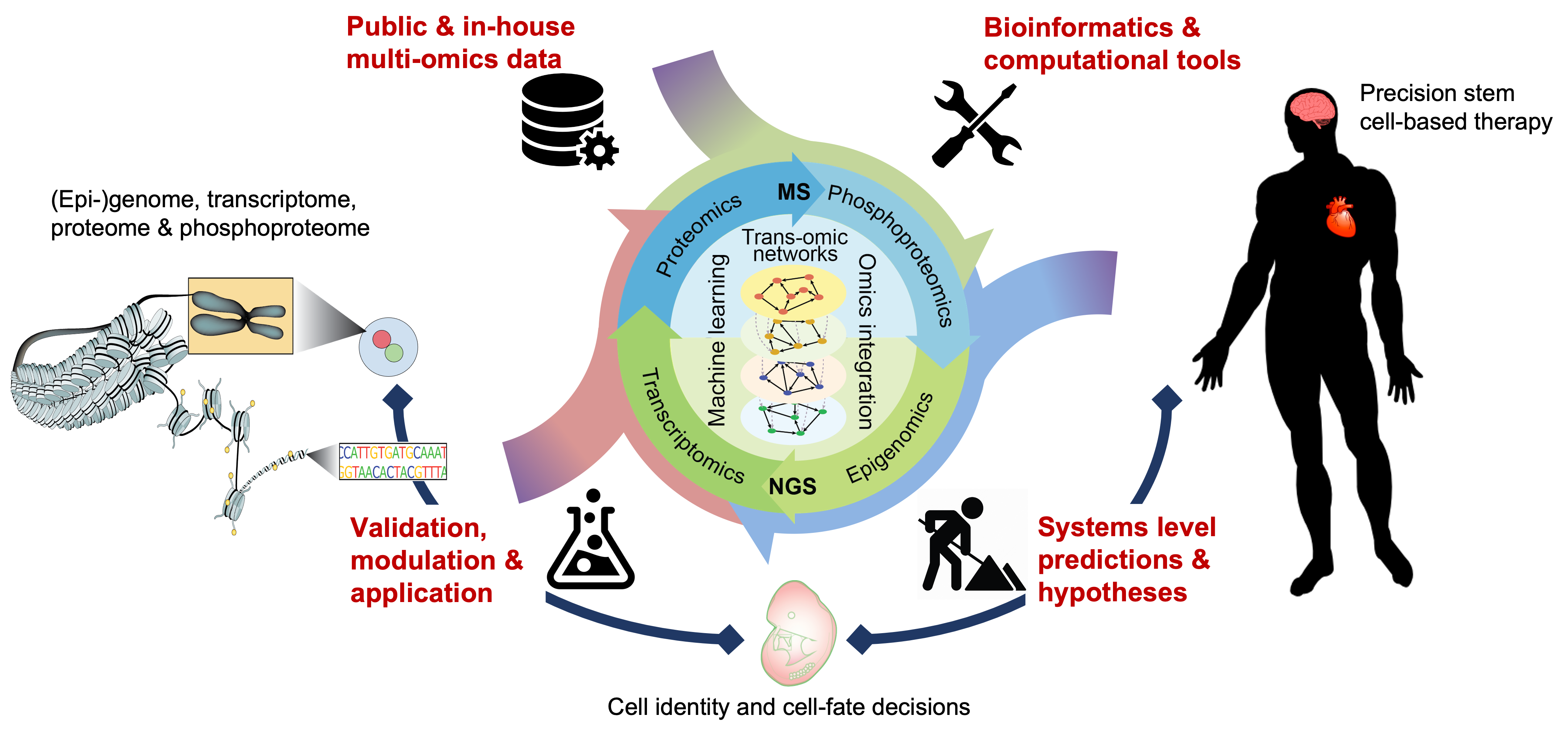
Our laboratory develops statistical and machine-learning methods to reconstruct and interpret these regulatory programs from single-cell, spatial and multimodal omics data. By integrating computational modelling with stem cell, organoid and disease biology, we aim to understand how cell identity is established, how cell-fate decisions are controlled, and how disrupted cell states can be linked to therapeutic opportunities.
Our research aims to:
- Develop interpretable AI and statistical methods for single-cell, spatial and multimodal omics.
- Reconstruct regulatory programs that control cell identity and cell-fate decisions.
- Model cell-state transitions during differentiation, organoid development and disease.
- Establish robust computational tools and benchmarks for the research community.
- Translate cell-state models into strategies for stem cell engineering, disease modelling and therapeutic prioritisation.